Free shipping on orders above R1000
Factory lights just don’t cut it for off-road adventuring, so how does one go about picking the best LED lightbarfor their 4x4? Here’s the short answer:
A combination beam LED light bar placed low on your 4x4 is your safest bet. Otherwise, you’ll either lack peripheral vision or you’ll lack power in your forward-facing spot beam. Be aware of the legislation surrounding the use of after-market LED light bars in South Africa. You’re much less likely to run into legal trouble if you make your light bar detachable and only use it when you need it.
Let’s quickly run through everything you need to know about choosing the best off-road lighting for your 4x4:
Price & Size
Step one is figuring out your budget. Not much more to say here - this is your call. You just need to be sure that what you’re buying will meet your off-road needs. Saving R1000 isn’t really saving if you’re going to redo your lighting in the near future.
Then you’ll need to measure the available space on your vehicle and decide where to place the light bar. They’re usually found on roofs, grills, bull bars, and bumpers in sizes ranging from 6 to 50+ inches.
A small LED light bar can throw a surprisingly strong punch. An 11-inch bar from the Hella ValueFit Pro Series can chuck 5400 lumens over 767 meters. You can also find 6-inch bars that shine over 322 meters.
Types of LED Light Bar Beam Patterns
Picking the right lighting for your off-road needs can be the difference between seriously damaging your metal baby and slowly but safely cruising through your obstacles. This ties back into your budget – if you get an LED light bar that isn’t good enough to keep you out of harm’s way, you’ll end up repairing damages that could have been avoided by using more appropriate lighting.
Spot Beams
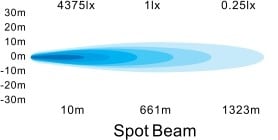
Spot beams are designed for maximum range and intensity at the cost of beam width, making them great for high-speed conditions. Since spot beams only provide 10-30 degrees of vision, pairing them with flood beams can be highly beneficial. However, LED light bars do spill a decent amount of light for peripheral vision, so you could be good to go without needing to complicate your lighting setup.
Flood Beams
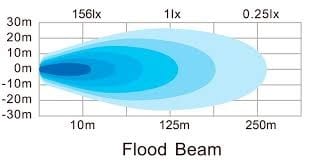
Flood beams sacrifice range and intensity to cover a significantly wider area. They provide up to 120 degrees of vision and are also great for work lights and reverse lights. Flood beams alone may not give you enough forward vision, so if you need to see far ahead, don’t forget to pair your flood beam with a spot beam.
Combination Beams
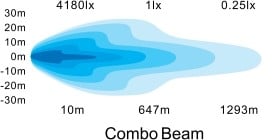
This is where LED light bars “shine”. Combination beams combine spot and flood beam patterns to create a more complete lighting setup. The versatility of using both optic types keeps your vehicle significantly safer while minimizing the need for wasteful upgrades. A combination beam LED light bar is more than enough for most off-road requirements – you’ll see a great distance ahead of your trail and have reliable peripheral vision.
Single Row vs Double Row LED Light Bars
Single row LED light bars feature strong spot beams at the expense of wider flood beams. If you need to see far ahead and aren’t concerned with your peripheral vision, a single row light bar would suffice.
Double row LED light bars can be programmed to function brilliantly as both spotlights and flood lights. Their wide and diverse lighting patterns make them a more one-and-done solution for both fast trails and slow crawls.
Having fewer bulbs doesn’t necessarily mean a single row light bar is weaker. The important factor is the wattage of the bulb. You could rig a single row light bar to be just as powerful as a double row bar, within reason.
Durability and weather resistance
Off-roading has more than its fair share of rocks, ditches, dust, and rain. Your LED light bar needs to be able to handle these conditions with relative ease. LED light bars from less reputable brands are known to have very little ingress protection and often fail within 6 months. A trusted product that features IP67 protection and uses stainless-steel mounting brackets should cover your off-road bases.
IP67 protection means that the light bar is resistant to dust and can be submerged under 1 meter of water for up to half an hour. If you suspect you’ll be going lower than 1 meter, IP68 offers protection for up to 1.5 meters (and the same amount of time).
LED Light Bar Legislation in South Africa
While factory-fitted LEDs are legal, after-market LED light bars are not, and should only be used off-road or on your farm.
Alta Swanepoel, a road traffic and transport expert, has stated that the reason for this is that all the lights on your vehicle need to be fitted equal distances apart from an imaginary vertical line that cuts through your car’s front logo.
LED light bars usually run right across this line, and even if you only use them off-road, it’s still illegal to have an after-market light bar on your vehicle. The best way to keep your 4x4 on the right side of the law is by using a detachable LED light bar setup.
Officers have the discretion to let you go if they’re happy with your reasoning and the appearance of your setup. If you’re clearly a farmer and your LED light bar is covered, they may decide against kicking up a fuss. However, I recommend not relying on goodwill - one day it might run out.
Where should you mount your LED light bar?
LED light bar placement boils down to the beam patterns you’re using, your lighting priorities, and where your vehicle has space.
Your safest bet is fixing your LED light bar onto your front bumper, grill, or bull bar. Low light bar placement avoids awkward glare from your bonnet or light spilling in through an open sunroof.
If you’re out in the bush, mounting your LED light bar higher will cast shorter shadows, so you’ll be able to tell the difference between a shadow and a massive hole in the ground. This obviously has huge benefits to you and your vehicle, and if you already have a roof rack that can accommodate an LED light bar, it’s worth considering placing it up high. Just remember not to place your light bar too far forward.
Spot beams can be placed nearly anywhere without causing excessive glare thanks to their incredibly narrow beam patterns. While flood beams can also be mounted up high, we recommended placing them down low for clearer vision and less glare. A combination beam LED light bar placed low on your 4x4 will meet most off-road requirements.
Remember to use the correct lights for on-road, high-traffic driving. The importance of being situationally aware of your surroundings cannot be stressed enough.
Other factors to consider before buying an LED light bar
Current and heat management
Overheating an LED can shorten its lifespan by up to 90% and creates damagingly excessive currents. A good light bar should have enough airflow within its housing to manage heat efficiently, use copper core circuit boards, and feature large aluminium heat sinks.
LED light colour temperature
Not all colours are born equal – some offer distinct advantages over others. White light is the brightest and most versatile, while amber lighting is the best for low visibility driving conditions like fog.
Colour temperature is measured in kelvin (K). Candlelight is 1900K, while daylight is around 5500K and a blue sky is 10 000K. Low kelvin lighting is great for piercing through bad weather conditions, but to see any reasonable off-road distance ahead without straining your eyes, you’ll need LED lights between 4500 and 6000K.
Warranty
No one plans to constantly cycle through light bars. Most reputable manufacturers will offer coverage for 1-10 years. Check the warranty before purchasing your LED light bar to manage your expectations accordingly.
According to Dewald Ranft, the Chairman of the Motor Industry Workshop Association (MIWA), sub-par lighting is an all-too-common issue for modern vehicles. This is particularly dangerous in South Africa as we have plenty of unattended wildlife roaming along outer-city roads. These conditions have created a massive after-market LED lighting industry.
Choosing the right LED spotlights for your vehicle not only determines your late-night safety, but also the safety of your license disc. So, if taking your 4x4 off road with factory lights isn’t good enough, then what is?
You should use LED spotlights that are ECE and CISPR25 Class 3 certified and built with effective heat management in mind. Stainless-steel mounting brackets are the most reliable option and end up being more affordable in the long run. Add dust and water proofing and you’re all set for the great outdoors. The ideal kelvin rating for a spotlight is between 4,800K and 6,000K. Pencil beam spotlights are great for busy roads like national highways, while driving lights make off-road adventuring safer by providing more peripheral lighting to reveal wildlife or twists and turns.
Let’s expand on the paragraph above and run through the do’s and don’ts of choosing LED spotlights:
Why LED Spotlights?
LED spotlights are compact and durable, which makes them perfect for bumpy off-road adventures. An average LED spotlight lasts around 50,000 hours, which is 2,083 days or just short of 6 years. LEDs are known for being highly efficient and draw remarkably less power than halogens, making them an environmentally friendlier choice too.
LEDs come with a cheekier price tag than halogens, but when you consider the difference in power usage and longevity, they end up being the more affordable option in the long run for your 4x4.
Remember to use LED spotlights appropriately (or not at all) when you’re in normal traffic. Nobody wants to drive blind, and a lot of people already struggle to drive at night due to nyctalopia (night blindness).
LED Spotlights vs Driving Lights
The classifications of vehicular lights can be confusing. While spotlights and driving lights look similar and are usually found in the same product category, their beam patterns are slightly different. A spotlight has a long, thin “pencil” beam while a driving light spills into your peripherals more.


How do you know which beam pattern to use?
If you’re driving on paved roads and national highways, you’ll want a spot beam. If you’re using backroads and gravel tracks, use driving lights. If you’re a beast of the bush and the road – use both!
Driving lights help you keep track of wildlife around the road, while pencil beams maximise your forward vision.
Spotlight Mounting Brackets
LED spotlight mounting brackets are often the first point of failure, so choosing the right brackets for your off-road spotlights is important.
Stainless steel mounting brackets take the cake, and while they occasionally get a bad rap for having a higher initial cost, they usually ends up being the more affordable option over time.
Adding chromium to steel creates a tough, invisible, and corrosion-proof chromium oxide film on the surface of the steel. Whether you damage this film mechanically or chemically, it will self-heal if oxygen is present (even in small amounts).
The benefits of using stainless steel include:
Kelvin Rating and Colour Temperature
A kelvin rating is used to describe the colour temperature of light on a scale of 1,000 – 10,000. The brighter the light is, the higher its kelvin rating will be. Daylight sits at around 5,500 Kelvin.
Overly bright lighting makes it difficult to define objects that would otherwise be clear, while lights that are too dim force you to squint and struggle to focus. Both ends of the spectrum will tire your eyes out quickly. Avoid eye strain and fatigue by using lights that resemble natural daylight. The ideal kelvin rating for 4x4 spotlights is between 4800K and 6000K.
Here are the colour temperatures of the various kelvin ratings:
| Kelvins | Colour Description |
| 1,000 | Ultra-Warm |
| 2,400 | Very Warm |
| 3,000 | Warm White |
| 4,000 | Cool White |
| 5,000 | Daylight |
| 6,000 | Cool Daylight |
| 10,000 | Sky Blue |
Radio Interference
A bad LED spotlight can cause radio interference – a headache that’s really not worth having. To minimise radio interference, make sure that your LED spotlights are CISPR25 Class 3 certified. This means that they’re built using only quality automotive parts that won’t disrupt any electronics already present in your 4x4.
Weather-resistance
LED spotlights are expected to perform reliably in a wide variety of road conditions. Unfortunately, the after-market lighting industry has been flooded in recent years with subpar products. This isn’t to say that there aren’t good, cheap spotlights on the market, but you’re always taking a gamble.
We recommend using lights that are IP 6K7 and IP 6K9K certified. The “6” means that the spotlight is dustproof, the “7” provides protection against temporary water immersion, and “9K” means that the spotlight is fully waterproof and can be high-pressure cleaned.
Spot Light Regulations in South Africa
Make sure your LED spotlights are ECE complaint. This is the standard set by Europe that has been adopted internationally. Spotlights that are certified will feature an “E-mark” that signifies compliance. The approval process for E-certification is meticulous and means that a producer cannot self-certify these standards. The importance of 3rd party verification cannot be understated.
Dewald Ranft (MIWA Chairman) says that spotlights should always be wired in a way that allows them to be disabled entirely by their own switch, as well as by the vehicle’s high beam switch.
It’s unfortunate that road traffic regulations haven’t kept up with on-road lighting developments. All spotlights must comply with the Road Act:
The lower you place your LED spotlights on your 4x4, the safer you’ll be, and choosing an LED spotlight over a light bar may prevent a headache or three in the long run.
LED Spotlight Casing and Overheating
Efficient heat distribution is a vital component of a good spotlight. You could be using the best LED technology in the market, but if the heat isn’t being handled appropriately, it’ll perform like a run-of-the-mill spotlight. When an LED spotlight overheats, it pulls back power output and leaves you scratching your head.
A good LED spotlight will have a strong case that has a black, fin-like structure on the back to distribute and dissipate heat efficiently. Driving quickly also helps keep spotlights cool, but that obviously isn’t an ideal solution. An LED spotlight from a trusted brand will have great heat management regardless of speed or wind.
